

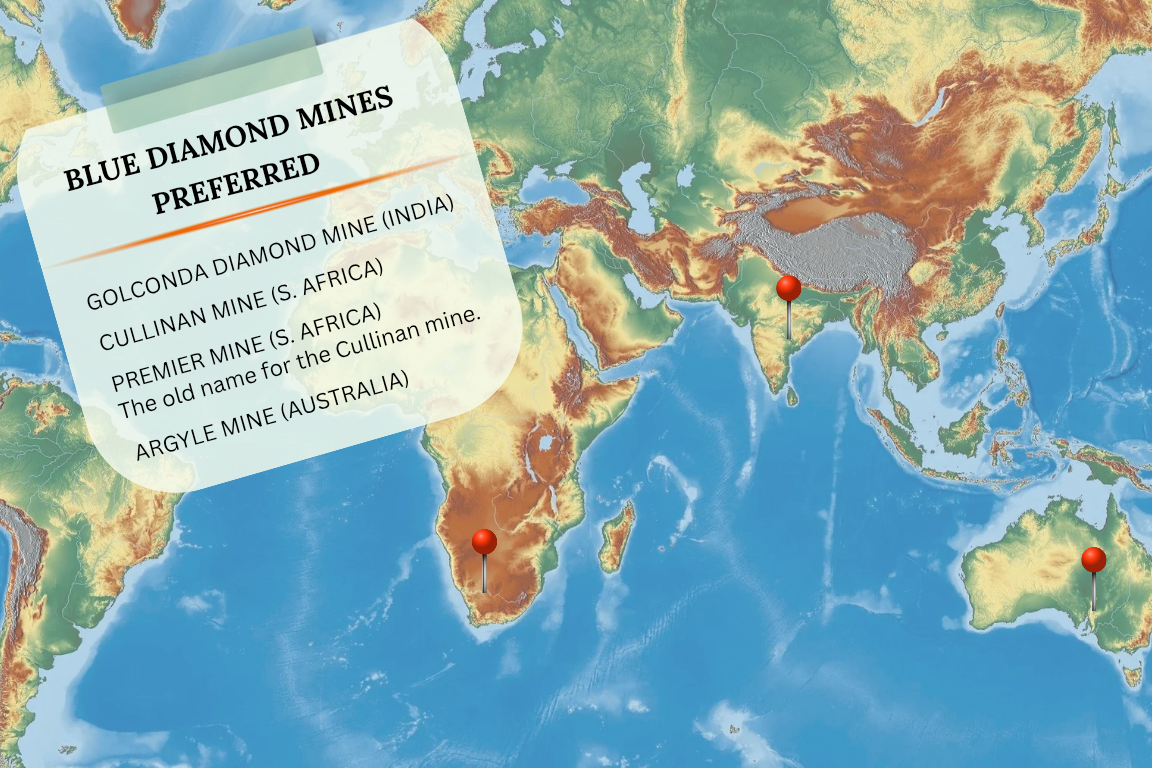
Blue diamonds are among the rarest of all naturally colored diamonds. Globally, less than 0.02% of all diamonds mined show a natural blue color. The blue hue comes from trace amounts of boron in the crystal lattice during formation — a geological event that’s already rare, and even rarer when fine quality blue diamond is formed.
Interestingly many mines never yield a single blue diamond in years of operation. This is often seen in the South African Cullinan mine, blue diamond recoveries are counted in single digits per year. While it is conventionally true that, larger blue color diamonds command a higher per carat price – blue diamonds with royalty in their provenance, fail to follow conventions. These diamonds can fetch exorbitantly high per carat prices at auctions, even when sizes are less than 10 carats.
Blue diamonds have been found in a few diamond mines across the world. The 4Cs (carat, clarity, cut and color) aside, the value of blue diamonds is also influenced, by the origin of the diamond. Simply put, the origin plays a big role in how the market perceives them.
Arranging the blue diamond mines based on preference of, connoisseurs, auction houses and diamond collectors, would be an exercise that is void of any debate or disagreement!
The Golconda Mines In India
Golconda blue diamonds are tied to centuries-old royal treasuries and legends. A tiny portion of Type IIb diamonds in the Golconda diamond mines, have a blue color – this due to the presence of boron in the diamonds.
The Golconda have ceased to be commercially mined for centuries — all Golconda stones are from historic finds, not new mining. This rarity adds to the desirability of blue diamonds from the Golconda region of India.
To name a few iconic blue diamonds that have originated from the Golconda mines – Hope Diamond, Wittelsbach-Graff, Seraphim Blue Diamond, Tereschenko, Golconda Blue Diamond and The Idol’s Eye.
The South African Diamond Mines
The Cullinan mine in South Africa was earlier referred to as the Premier diamond mine. The South African mines unlike the Golconda, mines which have been depleted centuries ago are still operational.
While the prestige attached to the famed blue diamonds from the Golconda mines is missing, in the case of blue diamonds originating from the South African mines – experienced collectors realize that, the chance of acquiring a historic Golconda blue diamond is extremely low. This ensures a fairly high demand for blue diamonds from the South African diamond mines.
Well known blue diamonds from the South African mines include – Oppenheimer Blue, Blue Moon of Josephine and The Zoe Diamond. It must be kept in mind that the Cullinan diamond mines in South Africa, are still operational. The possibility of finding more blue diamonds is always present.
Botswana Orapa Diamond Mine
This diamond mine is added to the list, to accept the fact that the Botswana diamond mine – holds promise. Occasional blue diamond finds are likely to continue but, such diamonds would lack historical significance. However, the commercial world of high priced diamonds, would sense a good opportunity to acquire a few diamonds, from the Orapa diamond mine in Botswana.
SUMMARY
Blue diamonds will always attract demand. As historic blue diamonds become increasingly rare, it will be stones from newer finds that draw the attention of diamond experts, collectors, and auction houses. The supply of blue diamonds will never keep pace with demand, as a very small fraction of diamonds mined each year, turn out to be gem quality blue diamonds. It takes billions of years for a natural diamond to form!
The wait for a historic Golconda blue diamond to come up for auction, can be very long. A highly publicized auction of the Golconda Blue Diamond was cancelled by Christie’s in May 2025. Diamond collectors now pin their hopes on the Seraphim Blue Diamond, an elusive diamond that was worn by the first Nizam of Hyderabad (around 1725) in an opulent turban ornament. A few diamond experts claim to have traced this legendary blue diamond, to a high value collection in Russia.